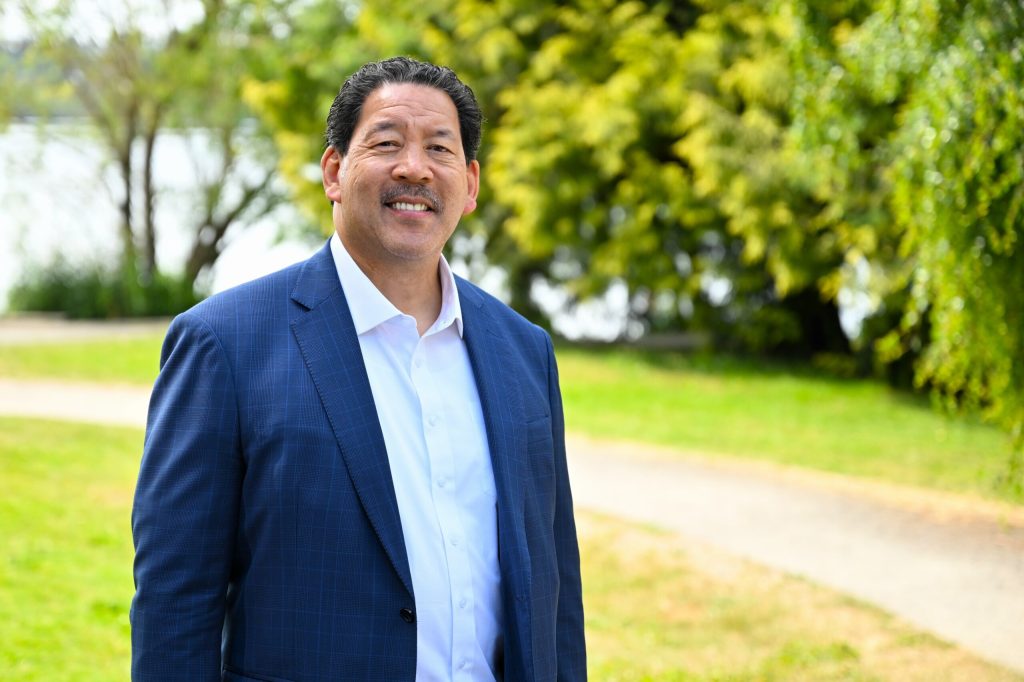
CANDIDATE: Bruce Harrell, Seattle Mayoral Candidate (Incumbent)
- Website: https://www.bruceforseattle.com/
- Instagram: https://www.instagram.com/bruceforseattle/
- X: https://x.com/bruceforseattle
- Bluesky: https://bsky.app/profile/bruceforseattle.bsky.social
- Facebook: https://www.facebook.com/BruceForSeattle
ARTS PLATFORM
My arts platform – and my proven arts record as mayor – is a holistic approach to supporting a diverse array of artists and arts organizations, both new and legacy, in their mission to expand access to the arts across Seattle. Through collaboration, programing, funding, and creative opportunities, we are helping to maintain and grow Seattle’s reputation as an incredible city for the arts. As mayor, my administration and I have been both collaborators and patrons of Seattle’s art scene.
I made it a priority to recruit a national talent in Gülgün Kayim as our director of the City’s Office of Arts and Culture. Director Kayim is a champion for community-based collaboration, and under her leadership the City’s Office of Arts and Culture is both advancing proven projects and creating innovative new programming by working directly with artists.
We championed the Hope Corps, directly creating opportunities for new and developing artists to advance their careers and bring their talent to audiences across the City. At the same time, we’ve supported major arts organizations like the 5th Avenue Theater and SIFF – demonstrating our commitment to a successful arts scene at all levels.
The arts have been front and center in my Downtown Activation Plan – recognizing that artistic expression and performance are central to a thriving and vibrant city center. This has taken a variety of forms, such as putting public art installations in formerly vacant storefronts through Seattle Restored or as centerpieces on our new Waterfront; supporting new ideas like Cannonball in the old Bed, Bath, and Beyond Space – and elevating innovative new takes on Seattle classics like the relaunch of Bumbershoot; as well as signing a lease agreement with Cultural Space Agency to bring five arts non-profits to King Street Station.
At the same time, we know we must do more to uplift the arts across the City – from the South End to Capitol Hill and north of the cut, as well as to empower representation through artists and organizations from communities of color.
Further, my administration has made Seattle’s creative economy a priority for the city, reorganizing our efforts and putting a focus on the creative opportunities and union jobs that can be created through production of visual arts like film and television. We reorganized our efforts by making this a focus of both our Arts and Economic Development departments, helped form a Film Commission to learn directly from the experts and community, and continue to recruit productions to come to Seattle.
One final area of work that can help summarize our comprehensive approach is in our efforts to address graffiti. It’s well known that I am no fan of the unwanted tagging that damages businesses and neighborhoods without consent. But instead of solely focusing on the punitive aspects of graffiti abatement, we’ve changed our approach to build connections with artists in the graffiti and street art community. I hired a leader in the street art community to help tap into talent and give those interested in this artform an outlet through funding, support, and approved canvases across the city. Through partnership and paint jams, this has allowed us to beautify our neighborhoods, turn gray walls into murals, and greatly expand public art, including over 80 new murals throughout Seattle.
The arts have been essential to my growth and happiness throughout my life – and I consider it a blessing that as mayor I can help support this same positive impact for neighbors across Seattle. In a second term, I will continue advancing efforts like those above, and big, new ideas, through collaboration with artists and the arts community.
How do the arts reflect the voices, perspectives, and communities in your district? What are challenges and opportunities?
Arts tell new stories, create enriching shared experiences, and bring neighbors together as the lifeblood of vibrant communities. Arts bring ideas and emotion, nostalgia and new perspectives, and bring us together by highlighting diversity and uplifting commonality. Arts offer a window into the life experiences of others, and I believe one of the greatest opportunities we have in supporting the arts is investing in a powerful tool for creating open minds and helping us learn about one another.
Arts allow us to better step into the shoes of those who are different than us – and this is especially important in the multi-culturally diverse city we call home. That’s why, as mayor, I’ve supported incredible organizations like the Wing Luke Museum and the Nordic Museum that expand cultural understanding, as well as programming like Songs of Black Folk, which creates an outlet for Seattle’s Black community to share the joy, songs and stories of Juneteenth and the Black experience with all of our neighbors.
We need to create more opportunities like this – especially as the arts’ long recovery from the pandemic has made it difficult for artists to find their footing or advance their careers. This is why investments like Hope Corps, as well as intentional collaborations with community are so important. We will continue these efforts to bring the arts to every neighbor and neighborhood in Seattle.
How do you envision the arts as part of Seattle, especially as part of critical issues including access, affordability, displacement, education, and racial equity? Do you have any policy ideas around addressing these issues?
These are some of the most serious issues facing our city – and the arts can help illuminate these issues and address them head on.
Modern day issues are at the heart of so many forms of artistic expression and storytelling – artists create awareness and drive understanding through their pieces. No matter someone’s background or the challenges they are facing, the arts can elucidate these issues and create greater shared understanding. Previously in this questionnaire, I have provided examples of how our administration is investing in the arts, and how that allows artists and performers to make art touching on these issues.
Further, the City can be even more thoughtful in this space – for example, our Office of Labor Standards commissioned artwork aimed at informing workers in the gig economy about new protections that exist in the City. We want to address Seattle’s most difficult challenges head on, and arts can be a gateway to a shared conversation.
I remain strongly committed to protecting admissions tax revenues for dedicated funding and investments toward Seattle arts. These revenues are critical for helping tell stories on the issues mentioned above.
Lastly, supporting programs for artists can help address these issues directly. Again, we have focused on creating new jobs and opportunities for artistic expression, such as through Hope Corps grants and efforts to strengthen the creative economy. These provide real dollars to artists or help drive new jobs, with a focus on providing real dollars to artists and access to opportunities for historically marginalized communities. Similarly, our Equitable Development Initiative has invested tens of millions of dollars toward preventing displacement and preserving the culture of our city, with a special emphasis on the arts and communities of color.
We’ve also supported significant efforts to expand affordable housing – opening more than 6,500 affordable units and expanding the Office of Housing’s portfolio by 27%, as we also grow market-rate housing and change zoning laws so more people can live in more neighborhoods across Seattle. One example is in Georgetown, where I signed legislation to allow new workforce housing and community spaces – with a focus on the arts – to be built. We’ll keep bringing this robust action and intentional effort to support artist housing and creative space in a second term.
The aftershocks of Covid and federal arts funding cuts are still being felt by artists and cultural organizations. Please share policy ideas you may have that aim to stabilize the cultural industry and increase cultural engagement to increase quality of life for communities across King County/Seattle? If you don’t have policy ideas right now, what process would you initiate to determine new opportunities in these areas?
Arts are essential to a vibrant and engaged city. Amidst the impacts of post-pandemic recovery and threats of funding cuts from the Trump Administration, I have carefully proposed funding to keep arts and culture alive in Seattle. In addition to the efforts I previously mentioned – Hope Corps, investments in major institutions, Seattle Restored, King Street Station, the One Seattle Graffiti Plan, and other new endeavors – I also want to highlight these initiatives that were included in my 2025-2026 proposed budget. I hope to continue to advance efforts like the following in a second term:
- Retaining funding for ARTS’ C.A.R.E. grant program in 2025 and 2026. This means that while King County’s Doors Open program infuses new resources into the community, we can continue to support small and mid-size organizations that Doors Open funding won’t reach. $2.5M in one-time funding to support
- Downtown Activation and in preparation for the FIFA World Cup, which includes:
- Neighborhood Arts, Culture, and Festival Activations
- Visual Arts Installations at Benaroya Hall
- Alleyway Activations and Art Installations
- Union/King Street Station Plaza Art Installations and Activations
- Community Engagement & Cultural Inclusion grants
- An additional $2M in 2025 and 2026 to provide financial support for linchpin Seattle arts and cultural institutions still struggling with post-pandemic recovery
How do you plan to work with governmental agencies including the Office of Arts and Culture and the Seattle Arts Commission?
Again, I am proud to have hired Director Kayim to lead the Office of Arts and Culture. When we hired her, we undertook a national search and formed a search committee with representation across art forms and organizations large and small. We sought to find a leader equipped to be the Seattle art scene’s strongest champion, to think big, and to bring our community together – and we found that in Director Kayim. I’m grateful to partner with Director Kayim to advance our shared mission. In a second term, I’ll continue to appoint members to the Arts Commission and other related commissions, like the Film Commission that my office helped lead efforts to form, and work alongside their members to advance big ideas and smart policies that benefit the arts.
We have a record of doing just that in my first term: Music Loading Zones are a great example. Our administration worked directly with the Music Commission, musicians, and industry leaders to advance a significant effort that brought together our departments like the Office of Economic Development and SDOT in a One Seattle Model. As a result, we helped create a new kind of permit, just for artists and musicians, at venues to support ease of set up and allow them to focus on their performances, not logistics.
Describe a meaningful arts experience that has stayed with you over time. How have the arts affected your life?
I recall many meaningful arts experiences that had a profound impact on me and my life. Music, arts, and poetic expression have always been important to me and my family. I believe these are the gifts and talents that we will be remembered by—not the budget appropriations for our roads or our laws. My father and mother attended the same school—Garfield High School. It was there that music had a powerful influence on my father’s life. It was at Garfield that my father found meaning – and friendship – in the Garfield High music program, performing with Quincy Jones, who later introduced him to my mom.
Arts experiences build hope and inspiration. The arts inspire people to fight for civil rights. These experiences help us get through the greatest challenges and the pain. I have observed that the arts make a difference in people’s lives and improve the world, one community at a time. I have lived these experiences in my community role as the board chair of a large African American arts facility on the west coast.
Finally, I believe the arts is a path by which we can reach our youth; and, likewise, our youth can reach us. This thought brings to mind a meaningful arts experience. In January 2017, when I was serving as the Seattle City Council President, I agreed to co-sponsor the Seattle Annual MLK Jr. Unity Day.
I could not have imagined that a cold night in Seattle’s Town Hall would turn out to be for many, including myself, a life-changing experience. The selection of music and the energy was exhilarating—I was transformed by the First Nation Native Drum Group & Ceremonial Prayer, Hip Hop Artist Gabrielle Teodros, Leija Farr (the first ever Seattle Youth Poet Laureate), the Sea-Town All Stars, and Soloists Josephine Howell and Stephana Sneed. And, during that evening, the inspirational message from Angela Davis clearly had an impact on the audience, the media, and me. It was electric and that experience transcended generations, cultures, genders, religion, and ideologies. In fact, that evening showcased the city’s diversity and forged partnerships with municipal leaders and community activists. The youth, the music, and Angela reached us—it was transformational.
 Seattle Arts Voter Guide